HP Lovecraft was an American writer of horror and science fiction who lived from 1890 to 1937. He was born in Providence, Rhode Island, and spent most of his life there. Lovecraft was an avid reader from a young age, and he was particularly interested in science fiction and horror stories. My first experience with HP Lovecraft was the cartoon the “Real Ghostbusters” who dealt with the creature Cthulhu. It piqued my interest and from there I had to find out more about this early 20th century writer.
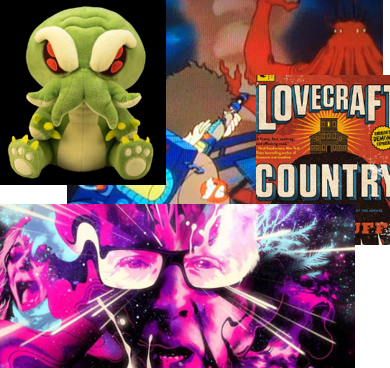
Lovecraft began writing his own stories in his teenage years, and he quickly developed a distinctive style that combined elements of horror, science fiction, and Gothic literature. His stories often featured grotesque creatures, ancient mythology, and cosmic horror, and they were noted for their vivid descriptions and intricate world-building.
Despite his talent as a writer, Lovecraft struggled to find commercial success during his lifetime, and he lived in relative poverty for much of his adult life. He was also known for his reclusive personality, and he spent much of his time writing letters to other writers and fans.
Lovecraft’s Difficulty in Hollywood
Despite Hollywood’s thirst for horror, it seems that HP Lovecraft’s stories but there may not be as many film adaptations of his work as one might expect. Firstly, Lovecraft’s stories often deal with abstract and existential concepts, such as cosmic horror and the insignificance of human beings in the face of vast and ancient entities. These themes can be difficult to convey on film, which relies heavily on visual and auditory stimuli to create an immersive experience. Secondly, Lovecraft’s stories often feature non-human or amorphous creatures, such as Cthulhu, that may be difficult or expensive to create convincingly with practical or digital effects.
Lovecraft’s True Horror
Lastly, Lovecraft’s work is also notorious for its racism and xenophobia, which has understandably led to some discomfort and criticism among modern audiences and filmmakers. While Lovecraft’s influence on the horror genre cannot be denied, his problematic views and language may make some filmmakers hesitant to adapt his work.
HP Lovecraft is known to have held and expressed racist and xenophobic views that are deeply problematic. Lovecraft’s letters and published works contain numerous examples of racist and bigoted language, which include derogatory remarks about African Americans, Jews, and other ethnic and religious groups.
In particular, Lovecraft expressed strong beliefs in the superiority of white people and their civilization, and he held a deep fear and disdain for people who were not of European descent. Lovecraft’s stories often feature monstrous, alien beings that embody his fears of racial and cultural diversity, and his work has been criticized for promoting a worldview that is exclusionary, intolerant, and harmful.
It is important to note, however, that Lovecraft’s views were not unique to him and were common in his time and place, and that many contemporary readers and filmmakers have engaged with his work in ways that are critical of his bigotry. Nevertheless, it is important to recognize and acknowledge the problematic elements of Lovecraft’s work, and to understand that his legacy is complex and contested.
That being said, there have been several successful adaptations of Lovecraft’s stories, including “Re-Animator” (1985), “From Beyond” (1986), and “The Call of Cthulhu” (2005), as well as more recent adaptations like “Color Out of Space” (2019). Although not his story but based on the world of and world around HP Lovecraft is Matt Ruff’s fictional book “Lovecraft Country.”
“Lovecraft Country” is a powerful work of fiction that uses horror to explore issues of race, social justice, and the legacy of HP Lovecraft’s problematic views on race. It is a compelling and thought-provoking read that has sparked important conversations about the intersection of horror and social issues.
Whatever the reason, whether its problematic thought, difficulty translating abstract concepts, or previously failed attempts keeping Hollywood from Lovecraft, it brings up an interesting dilemma between great fiction from a not-so-great human.

 The Daily Think
Leave a comment