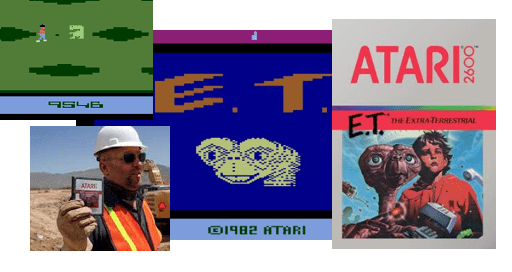
The Atari game E.T. the Extra-Terrestrial is often cited as a major factor in the video game industry crash of 1983. The game was released in December 1982, and while it was highly anticipated due to the success of the movie of the same name, it was ultimately a commercial and critical failure.
PRODUCTION
The game E.T. the Extra-Terrestrial was developed for the Atari 2600 console by Howard Scott Warshaw, a game developer at Atari. Warshaw was given a very short timeline of five weeks to complete the game in order to have it ready for release in time for the lucrative Christmas shopping season in 1982.
The development of the game was challenging, as Warshaw had to work quickly to design and code a game that was based on the popular movie, E.T. the Extra-Terrestrial. Warshaw was given little guidance or input from the movie’s creators, and had to come up with the game’s concept and design largely on his own.
The game’s development was further complicated by technical limitations of the Atari 2600 console, which had limited processing power and memory. Warshaw had to work within these constraints to create a game that would run smoothly and be playable on the console.
Despite the challenges, Warshaw was able to complete the game within the tight deadline, but the final product was riddled with bugs and design flaws. The game’s mechanics were difficult to understand and navigate, leading to frustration among players. Additionally, the game’s graphics and sound were underwhelming compared to other games of the time.
RELEASED BUT FLAWED
There were several reasons for the game’s failure. For one, it was rushed into production to meet a tight deadline in time for the Christmas shopping season, resulting in a poorly designed and buggy game. Additionally, the game’s gameplay and objectives were confusing and difficult to understand, leading to frustration and disappointment among players.
As a result, the game received overwhelmingly negative reviews and was a commercial disaster, with Atari reportedly producing more copies of the game than there were Atari consoles in existence at the time. The game was a major financial loss for Atari, which was already struggling with other issues such as competition from other consoles and a glut of low-quality games flooding the market.
WHAT HAPPENED TO THOSE UNSOLD CARTRIDGES?
After the commercial failure of the E.T. the Extra-Terrestrial game for the Atari 2600, there were reportedly millions of unsold cartridges sitting in warehouses. In an effort to get rid of the excess inventory, Atari reportedly buried the cartridges in a landfill in Alamogordo, New Mexico in 1983.
The burial of the cartridges in Alamogordo became the subject of much speculation and urban legend over the years, with some people questioning whether it was really true or simply a myth. However, in 2014, a documentary film crew unearthed a cache of Atari cartridges in a landfill in Alamogordo, confirming that the legend was in fact true.
The excavation of the landfill was led by a company called Fuel Industries, which had obtained permission from the city of Alamogordo to excavate the site. The excavation uncovered thousands of Atari cartridges, including many copies of E.T. the Extra-Terrestrial, as well as other games and gaming equipment.
The discovery of the buried cartridges generated a great deal of interest and media coverage, with many people seeing it as a bizarre and intriguing footnote in the history of the video game industry. The cartridges that were recovered from the landfill were sold on eBay, with some of them fetching high prices from collectors and enthusiasts.
LESSONS LEARNED
The failure of E.T. the Extra-Terrestrial contributed to a broader crisis in the video game industry, with consumers losing faith in the quality and value of video games. This led to a significant drop in sales and revenue for video game companies, and many smaller game developers and publishers went out of business.
The struggles of the game’s creator, Warshaw, were not limited to the development process. After the game’s release, it was met with overwhelmingly negative reviews and poor sales. Warshaw was personally criticized for the game’s poor quality, which caused him to feel immense pressure and self-doubt. He eventually left Atari in 1984 and left the video game industry altogether, citing the stress and pressure of the job.
Overall, the production and coding behind the game E.T. the Extra-Terrestrial was rushed and fraught with challenges, which ultimately contributed to the game’s poor quality and negative reception. The struggles of the game’s creator, Warshaw, highlight the intense pressure and scrutiny that game developers face, especially in the high-stakes world of video game development.
Ultimately, the video game industry would recover and continue to grow in the years following the crash of 1983, but the lessons learned from the failure of E.T. and other factors that contributed to the crash would shape the industry for years to come. Video game companies became more cautious in their approach to game development, and quality control measures were put in place to ensure that games were thoroughly tested and well-designed before release.



 The Daily Think
Leave a comment