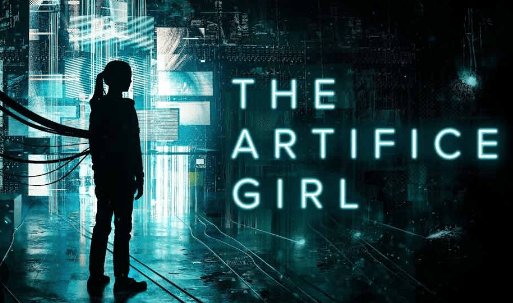
Having recently revisited The Artifice Girl, the film presents your typical characters, plots, and dramas. However, it manages to captivate, providing a mental escape from the unfolding narrative and encouraging contemplation on the ethical dimensions of artificial intelligence.
Film Credits: Written and Directed by Franklin Ritch and starring Tatum Matthews, Lance Henriksen, Sinda Nichols, David Girard and Franklin Ritch himself (April 2023.)

The central question that emerges is: What lies beyond the uncanny valley? As artificial entities become more human-like, how do we navigate the challenges of creations evolving beyond Turing’s pass/fail grading systems?
Crossing the Uncanny Valley
The term “uncanny valley,” coined by Masahiro Mori in the 1970s, describes the discomfort experienced when artificial entities closely resemble humans. Successful crossing of this valley involves creating entities that elicit a positive emotional response, a task easier said than done in the realm of artificial intelligence.

As we progress, the issue arises of whether we will intentionally program or inadvertently grant artificial entities the ability to achieve superintelligence. Will they adapt and master their environment like alpha predators?

Superintelligence
Superintelligence, a hypothetical state where AI surpasses human cognitive abilities, introduces a new set of challenges. As we contemplate crossing this frontier, we delve into a realm where AI becomes not just intelligent but potentially self-aware.
Self-Awareness

In human terms, self-awareness involves recognizing oneself as a distinct individual with thoughts, emotions, and a unique identity. This cognitive capacity is tied to consciousness, a fundamental aspect of human intelligence. In the realm of AI, self-awareness is a theoretical concept. Imagining a machine understanding its own existence introduces philosophical questions about the nature of consciousness.
The Artifice Girl prompts us to ponder these high-level philosophical concepts, intertwining them with the evolving landscape of artificial intelligence. Beyond its well-thought-out plot and compelling performances, the film raises existential questions that parallel the growth of AI.

In decoding these themes, we confront questions about existence and our coexistence with machines. What does it mean to exist alongside potentially self-aware machines? Is this a threat or an opportunity? Ultimately, the film serves as a catalyst for individual reflection on the intersection of humanity and AI, urging us to consider the implications as we navigate the evolving landscape of technology and consciousness.



 The Daily Think
Leave a comment